
Particle sizes and aerosols
Size Determines Behavior — Not Just Risk
When people think about respiratory viruses, they often imagine the virus itself as the thing moving through the air. In practice, individual virus particles almost never travel alone. They are carried within droplets and aerosols produced when people breathe, speak, cough, or sneeze - particles that can be hundreds to thousands of times larger than the virus itself.(1 2)
This distinction matters because it changes how we understand everything from transmission to filtration. A mask does not encounter individual virions. It encounters the droplets and aerosols that carry them.
What Are Aerosols and How Are They Different From Droplets?
The terms aerosol and droplet are often used interchangeably, but in respiratory science they describe distinct categories with different physical behavior.
Respiratory droplets are the larger particles produced during activities like coughing and sneezing. They are typically greater than 5,000 nanometers (5 microns) in diameter, and during a forceful cough or sneeze can reach 1,000,000 nanometers or larger. Because of their mass, larger droplets are strongly influenced by gravity and tend to fall toward surfaces within a relatively short distance of the source.
Aerosols are smaller, typically below 5,000 nanometers, and behave differently.(3) Particles in this size range can remain suspended in the air for minutes to hours rather than settling immediately. In enclosed spaces with limited ventilation, aerosols can accumulate and travel beyond the immediate vicinity of the person who produced them.(1) It is this property that makes aerosol transmission an important consideration in poorly ventilated indoor environments.
The boundary between these categories is not sharp. Droplets evaporate as they travel, losing water and shrinking in size, a process that can shift a particle from droplet to aerosol behavior mid-flight while the viral material it carries becomes more concentrated in the remaining residue.(4)
How Small Are the Particles Involved?
Understanding the actual scale of these particles is difficult without reference points. A human hair is approximately 70,000 - 100,000 nanometers in diameter. A visible speck of dust is roughly 25,000 - 50,000 nanometers. Against that backdrop, here is where the relevant particles fall:
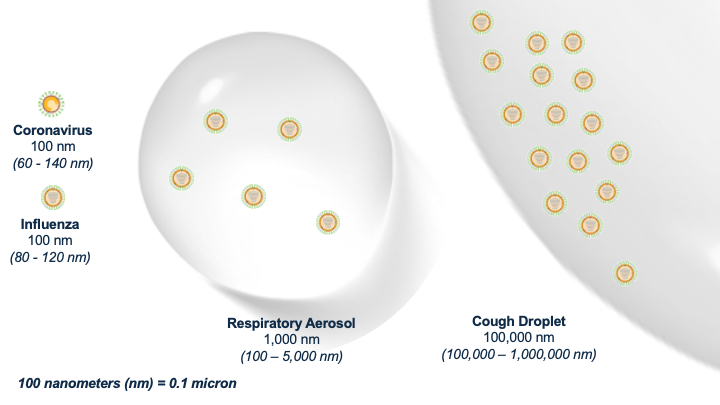
Figure 1. Relative sizes of respiratory particles. A coronavirus and influenza virion are each approximately 100 nm in diameter. A typical respiratory aerosol (shown here at 1,000 nm) is roughly 10 times larger and can carry multiple virions within it. A cough droplet, shown at 100,000 nm, is ~1,000 times larger than a single coronavirus or influenza virion and may contain many hundreds of virus particles depending on viral load. Virions shown inside the aerosol and droplet illustrate that viruses are almost never encountered as free-floating individual particles in the air. Note: 100 nanometers (nm) = 0.1 micron (µm).
To put the proportions in the image in further context: if a single virion were scaled to the size of a marble, a typical respiratory aerosol at 1,000 nm would be roughly the size of a grapefruit. A cough droplet at 100,000 nm would be the size of a small car. At the upper range of cough and sneeze events, 1,000,000 nm, the droplet would be the size of a house.
This is why individual virion size is rarely the relevant scale for mask filtration. What a mask encounters first is the carrier particle, a droplet or aerosol that is orders of magnitude larger than the virus inside it.
Why Individual Virus Size Still Matters
Even though viruses travel within larger carrier particles, the size of the individual virion remains relevant to mask science for two important reasons.
Filtration testing. Standardized laboratory tests often use challenge particles as small as ~30 nanometers, approaching the lower end of virus particle sizes. This represents a deliberate conservative choice: these are among the smallest biologically relevant particles a mask might be expected to encounter, reflecting conditions where aerosols have dried or evaporated significantly during flight. A mask that performs well at this scale has been evaluated against a demanding benchmark.
What happens after capture. When a droplet contacts a fiber in the filter, it does not remain intact. It spreads, partially evaporates, and breaks apart across the fiber surface, leaving behind smaller residues that still carry viral material. As this occurs, the relevant size scale shifts from the original carrier droplet toward smaller aerosol residue and, eventually, individual virion scale. Captured material on a mask is not static, which is one reason the full lifecycle of a captured particle matters to mask design.
Cough and Sneeze Events: A Closer Look
A cough or sneeze releases a plume of respiratory fluid containing particles across a very wide size range, from large droplets visible to the naked eye, down to fine aerosols requiring instruments to detect.(5) A single cough has been shown to produce tens of thousands of droplets; a forceful sneeze can produce up to 40,000 particles spanning this entire range.
The distribution within that plume is not uniform. Larger droplets carry a greater share of total fluid volume and, when viral load is high, may each contain many virions. Smaller aerosol particles are far more numerous but individually carry less fluid. Whether a given particle carries any virions at all depends on the concentration of virus in the respiratory fluid at the time of production, which varies significantly between individuals and over the course of infection.
During normal breathing, the distribution shifts toward the smaller end of the aerosol range. Speaking increases aerosol output meaningfully. Singing, exertion, and heavy breathing increase it further. This is why prolonged time in enclosed, crowded, poorly ventilated spaces represents a higher-risk exposure condition than brief outdoor contact.
What This Means for Mask Filtration
The wide size range of respiratory particles directly shapes how masks must be designed and how their performance is interpreted.
At the large end of the spectrum, cough droplets in the ten thousands to hundreds of thousands of nanometers, physical interception by mask fibers is highly effective. These particles are large relative to fiber diameter and are reliably captured through direct impaction. At the smaller aerosol end, particles in the 100–5,000 nm range, size-based blocking alone is insufficient. Capture depends on additional mechanisms: diffusion (Brownian motion bringing small particles randomly into contact with fibers), electrostatic interaction with charged filter surfaces, and interception as particles follow curved airflow around fibers.(3)
Understanding that masks encounter particles across this full-size spectrum, and that different capture mechanisms dominate at different scales, is essential context for interpreting filtration ratings and comparing mask types.
References
Hinds WC. Aerosol Technology: Properties, Behavior, and Measurement of Airborne Particles. Wiley-Interscience, 1999.
Xie X, Li Y, Sun H, Liu L. Exhaled droplets due to talking and coughing. Journal of the Royal Society Interface.2009. https://royalsocietypublishing.org/doi/10.1098/rsif.2009.0388
Centers for Disease Control and Prevention. Scientific Brief: SARS-CoV-2 Transmission. https://archive.cdc.gov/www_cdc_gov/coronavirus/2019-ncov/science/science-briefs/sars-cov-2-transmission.html
Vejerano EP, Marr LC. Physico-chemical characteristics of evaporating respiratory fluid droplets. Journal of the Royal Society Interface.
Bourouiba L. Turbulent gas clouds and respiratory pathogen emissions. JAMA. 2020;323(18):1837–1838.